
This is not the list I would have given you years ago when I was busy in our restaurant making great food for our guests! That list would have taken pages, and at that time I thought I needed it all. There is something about living in 125 sq.ft. that really changes you though. I didn’t want to be crammed in a tiny house living around my kitchen equipment, so I had to learn a whole new way of cooking that was simple and authentic without sacrificing the freshness and quality that I loved so much.
My answer was to get rid of the appliances—with the exception of the blender—and simplify everything. Now before you start thinking of me as some weird kitchen radical, let me assure you that your ancestors and mine thought cooking with these 10 tools was the most natural thing in the world. And they still ate great food. With all our grand technology we’ve managed to make food faster, but we have not made food better. So how do we go back to the basics? What do we really need for cooking great food simply in a micro-kitchen (or any kitchen) without sacrificing flavor or contentment?
CUTLERY
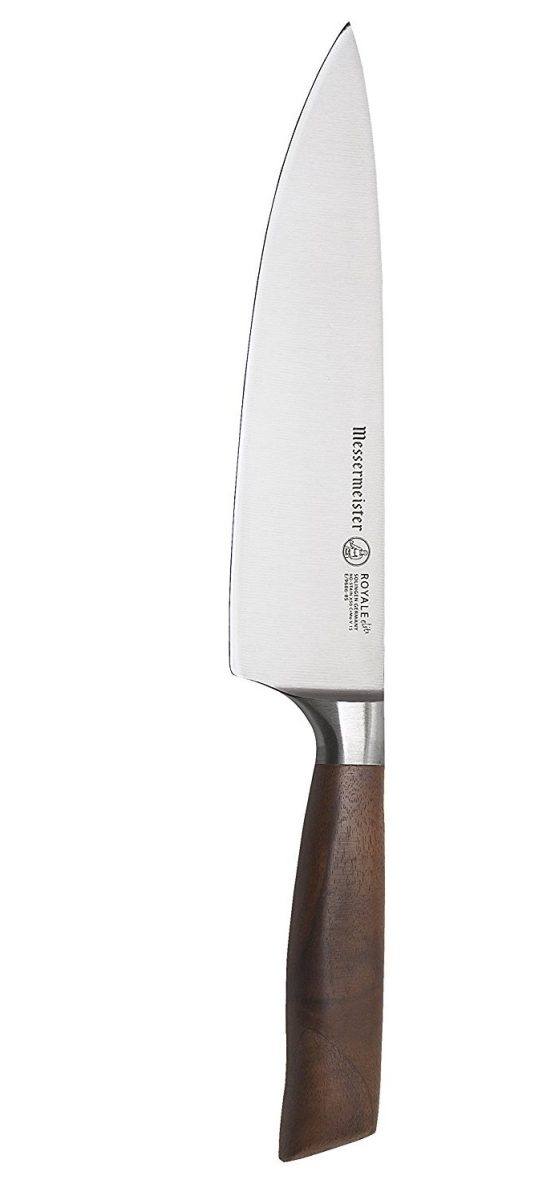
Three good knives, a cutting board, and the ability to sharpen a knife, this is where we begin. The three knives include a 5-7 inch Santoku knife, a 2-3 inch paring knife, and a serrated knife blade (for bread, tomatoes, and the occasional steak) and they don’t have to be some snobby luxury brand, but they should be good quality. High quality knives will hold an edge longer, so less sharpening is required. My favorite splurge brand is Messermeister. That German steel is gorgeous and feels heavenly. I’ve used Cutco knives for years and they are also great. Many of my chef friends choose Wustof knives. The brand isn’t the important part here, these three specific kind of knives are the keys to the kitchen kingdom! Three good quality knives are worth a whole drawer full of poor quality ones!
CUTTING BOARD
If you have good knife skills (and if not, YouTube is your friend) then you can slice, dice, shred, and grate with a knife and cutting board thus eliminating the need for a power hog food processor. I have a grater, but I’m more inclined to cube cheese with a knife and it works just as well in recipes that way. In fact, a knife and cutting board in skilled hands can do what many specialty kitchen tools do, but without the demands of space and power. And a knife and cutting board will always be easier to clean!
MUG
You’ll need the ability to sharpen those beautiful knives and so turn your coffee mug upside down and sharpen your knife on the rough bottom edge of the mug. That’s the simplest way to sharpen a knife that I know, and it means you don’t have to keep a tool for sharpening if you don’t want to. If you’re keeping score, that’s three good knives, a cutting board, and a mug.
KETTLE
Speaking of the mug, it’s entirely possible to make a cup of coffee using only a coffee mug and a whistling tea kettle. I’m so BAD that I need to use a whistling kettle or I’ll boil the forgotten saucepan dry as I am distractedwith something/anything else (ooo..shiny!). My Austrian husband puts coffee grounds in the bottom of his favorite mug, then he pours hot water over it. He waits until the coffee grounds sink or he stirs it a bit with a fork just on the surface. When the grit sinks to the bottom, the coffee is ready to drink and he drinks all but the bit in the bottom. What could be simpler? This is called “cupping” and Q-Graders make coffee in this manner to test the roast of the coffee beans, and also to create and test a bean blend. So while it’s the simplest coffee approach I can imagine, it’s also precisely the way the serious coffee snob/pros develop their product lines. Who knew simplicity was the key to a great cup of coffee? If the grit bothers you, use a tea pincer spoon. Still simple, still easy to clean, and still avoids the use of a disposable paper liner/filter. It works great for tea also.

SKILLET
Finally, the other masterpiece of any kitchen is the cast iron skillet. I use mine to sauté, braise, and roast savory things, but I also use it as a baking pan and it’s wonderful for focaccia bread, corn bread, and cookie bars. In fact, a cast iron skillet is equally useful in your kitchen as it is outside over an open fire or on a rocket stove. Bake lasagna, quiche, strata, or cinnamon rolls. Put graham crackers in there with a piece of chocolate on each and a marshmallow on top, and toast them under the broiler until they melt for beautiful indoor s’mores. Make your panini sandwich or make delicate crepes. Pretty much anything is possible and instead of keeping a bevy of skillets and baking pans, use this one instead. A cast iron skillet is available for about $20 in the humblest places, including antique stores since they are pretty much indestructible. You can find enameled versions in a wide range of colors at the gourmet kitchen shops at a premium price if you like, but the $20 version works just as well.
If you’re keeping score, that’s (3) good knives, (4) a cutting board, (5) a whistling tea kettle, (6) coffee mug, and (7) a cast iron skillet.
There are a lot of great meals that can be made with just these simple tools. Throw in a (8) mixing bowl and a (9) wooden/bamboo spoon and you can make a lot of great food! Throw in a whisk (10) and you can whip cream or make gravy or stir chocolate ganache until it’s velvety. Or my personal favorite: Pavlova. It’s amazing what is possible with these 10 simple kitchen tools.
If you’re considering going tiny, and haven’t taken the plunge, here’s how you can get ready for the big move and make all kinds of extra space in the kitchen you currently enjoy. Get some boxes, empty everything in your kitchen into them except the items mentioned above (and a few plates and some flatware, of course). Then clean out the cabinets into the boxes. Yes, literally.
Finally, put these boxes somewhere else. By “somewhere else” I mean the garage, upstairs, downstairs… basically any kind of “somewhere else” will do, as long as it takes a few seconds to get there and you have the space to put the boxes of kitchen stuff where it won’t be bothered. Every time you need something from this collection, you’ll either save yourself the trip and find a more creative way of using the tools you already have at hand in the kitchen. Or you’ll decide that you actually need the item badly enough that you’ll make the quick run to find the item. After a month, everything that you actually need will have magically migrated back into your kitchen. If your “somewhere else” is far enough away, you’ll cut fresh garlic with your knife rather than running for the garlic press. You’ll make rice in a saucepan on the stove rather than in a rice cooker. You’ll realize that you never actually use the bundt cake pan, and you’ll find that you didn’t use the plastic outdoor plates but once anyway. And all that Christmas stuff is starting to look kitschy anyway.
At the end of the month, take a look around your kitchen. Does this minimalist collection surprise you?
Revisit the boxes that were “somewhere else” and rescue anything that you know to be useful and believe to be beautiful (a line liberally borrowed from William Morris). Emphasis on the “believe to be beautiful” part here, because you’ve already rescued the useful items. This is where I got rid of the “everyday” dinnerware and started using the “good china” and traded in my plastic ladle for the copper one.
The next step is getting rid of the extras.
I find that using Craigslist and Facebook Marketplace lead me to despair of humanity, so use at your own risk. The happier and easier choice is to simply close up those boxes and cart them off to your favorite charity, which will save you five wasted trips, four no-shows, three headaches, two tantrums, and a partridge in a pear tree.
And at the end of this crazy ordeal—I mean adventure—you’ll have room in your cabinets and you’ll be ready to cook all your favorite dishes in a tiny house kitchen. Triumph!
Written by: Carmen Shenk for Issue 85 of the Tiny House Magazine


$108/$60
*Yearly PDF – 45% OFF cover price
12 Issues
Recurring Payment until canceled!
So just cowboy coffee, or do you use a sock to strain with? 😉 I love the coffee mug as a whet stone, maybe with a belt as a strop. Then you can get rid of your shaving gear too! But currently we here are living in a 3-generation household, and I’m not in charge of the kitchen, so I have to put up with ludicrous piles of colanders, redundant bowls, serrated knives, single-use tools and 7 or 8 hotpads. The sad irony is that I can see our in-progress tiny house from the kitchen window, waiting for me to have time to work on it! Haha! On the bright side, it’s daily practice in stoicism.